Posts

Call to make agricultural research more democratic intensifies as World Food Day is marked today

Image
BY EDMUND SMITH-ASANTE Professor Olivier Schutter The United Nations’ Special Rapporteur on the Right to Food, Professor Olivier De Schutter, has backed citizens worldwide who are demanding a fundamental shift in food and agricultural research to make them more democratic and accountable to society. De Schutter outlines his support in the foreword to a multimedia publication that the International Institute for Environment and Development (IIED), an independent, non-profit research institute based in London, UK, is set to launch today during the commemoration of World Food Day (16 October). He writes in the multimedia e-book titled Democratising Agricultural Research for Food Sovereignty in West Africa, that “The democratisation of agricultural research is vital for those who seek to make the human right to adequate food a reality.” Still in the foreword, the UN’s Special Rapporteur further applauds “the efforts that led to citizens’ jur...

Accra Ring Road Rotary celebrates silver jubilee

Image
BY EDMUND SMITH-ASANTE The Rotary Club of Accra Ring Road Central has launched the celebration of 25 years of dedicated community service in Ghana under the theme: “25 years of Selfless Rotary Service”. As part of the celebrations which run till the end of the Rotary year 2010-2011, the club has planned activities including the rebranding of a bus stop along the Ring Road, Accra, completion of a project at a village in the Akuapem North District – the Asempanaye School project, a presentation of the 4Way Test Plaque and an Anniversary Gala to climax the year long activities  in June 2011. Commenting on the celebrations, the President of the club, Rotary President, Galina Okartei-Akko, said she was excited about the achievements of the Rotary Club of Accra Ring Road Central for the past 25 years. “It is an honour to serve as the 25th president of the RC of Accra Ring Road Central. RRC has indeed come a long way building communities and bridging continents with the s...

2010 Global Hand Washing Day focuses on saving lives

Image
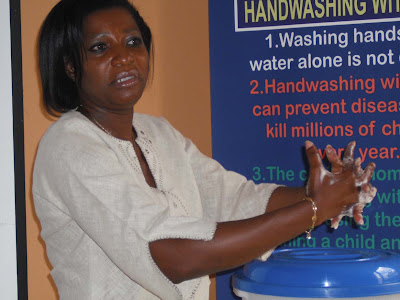
BY EDMUND SMITH-ASANTE Mrs. Theodora Adomako-Adjei demonstrating how to effectively wash the hands This year, the observance of the Global Handwashing Day began in 2001 by a coalition, comes off today Friday October 15, 2010 with its focus on “Saving Lives Through Handwashing With Soap.” Ghana joined the bandwagon in 2006 and began marking the day with the rest of the world  in 2008. In a statement issued to mark the day, the National Coordinator for the event in Ghana, Theodora Adomako-Adjei says the practice of handwashing with soap has become one of the international hygiene agenda, as a result of which the United Nations General Assembly has designated October 15 as the Global Handwashing Day. She said this is intended to echo and reinforce its call for improved hygiene practices, adding, “The guiding vision of Global Handwashing Day is a local and global culture of handwashing with soap.” Theodora Adomako-Adjei, who is also the Regional Extension Services Spe...

29 countries worldwide extremely hungry

BY EDMUND SMITH-ASANTE Twenty-nine countries have levels of hunger that are alarming or extremely alarming, says the 2010 Global Hunger Index (GHI) report released today. The report, co-authored by the International Food Policy Research Institute (IFPRI), Concern Worldwide and Welthungerhilfe, both international NGOs, says among the world’s regions, South Asia and Sub-Saharan Africa continue to suffer from the highest levels of hunger, stressing that “these results represent extreme suffering for millions of people.” “Most of the countries with ‘alarming’ GHI scores are in Sub-Saharan Africa and South Asia,” it states. According to the 54-page Global Hunger Index (GHI) 2010 report; “Twenty-nine countries still have levels of hunger that are ‘extremely alarming’ or ‘alarming,’” adding that “The countries with “extremely alarming” 2010 GHI scores – Burundi, Chad, the Democratic Republic of Congo, and Eritrea – are in Sub-Saharan Africa. Apart from the fact that the four c...

Improving child nutrition will reduce global hunger

Image
BY EDMUND SMITH-ASANTE A new Global Hunger Index (GHI) report released today in Washington DC, has identified malnutrition among children under two years of age as one of the leading challenges to reducing global hunger, stating that it can cause lifelong harm to health, productivity, and earning potential. The report has thus recommended that “To improve their scores, many countries must accelerate progress in reducing child malnutrition,” adding that considerable research shows that the window of opportunity for improving nutrition spans from conception to age two. It proposes further that to reduce global hunger, countries must target interventions where they will do the most good – among pregnant and breastfeeding women and children in their first two years of life. The GHI also tasks countries to address the underlying causes of under-nutrition, including poverty, gender inequality, and conflict; engage, empower, and support those working at the local level to improve nutriti...

Global Hunger Index confirms Ghana on track to eliminating hunger

Image
BY EDMUND SMITH-ASANTE A Typical Food Market in Ghana The Global Hunger Index (GHI) report for 2010 released today has confirmed that Ghana is on track to meeting the Millennium Development Goal (MDG) target of reducing by half the percentage of its population who are hungry, by 2015. “Only one country in Sub-Saharan Africa – Ghana – is among the 10 best performers in improving their GHI score since 1990,” says the report, which is titled “The Challenge of Hunger: Focus on The Crisis of Child Undernutrition”. According to the 2010 GHI prepared jointly by the International Food Policy Research Institute (IFPRI), Concern Worldwide and Welthungerhilfe, Ghana was the seventh among 10 countries worldwide considered as winners in their ability to downsize the number of hungry people from the period 1990 to 2010. It states that Ghana was able to reduce its hungry by 57%, whilst Kuwait topped the group with 73% and Peru at the bottom with 54%. The rest on the table were, Malaysia – 63...

UK worst victim of global money counterfeiting

BY EDMUND SMITH-ASANTE Although a host of countries all over the world are plagued by the menace of counterfeiting of their currencies, the United Kingdom (UK) tops the list of countries worst affected. The Bank of England is however working feverishly to address that challenge and was able to reduce the rate of counterfeiting of its Pounds Sterling from 1,000,000 notes to about 750,000 in 2009, latest reports say. This came to light during a Bank Note and Cash Processing Education  programme organised for the media in Accra Thursday by the Bank of Ghana (BoG) in collaboration with De La Rue, UK printers of the Ghana Cedi. Information gleaned from the Bank of England’s website, nonetheless states that during calendar year 2009 the number of counterfeit Bank of England banknotes taken out of circulation was around 566,000 with a face value of £11.1million. To the Bank though, compared with the average number of genuine banknotes in circulation, of over 2.4 billion notes, the in...

How well do you know the Ghana cedi?

BY EDMUND SMITH-ASANTE Until a group of journalists were quizzed on the picture behind Ghana’s current biggest bank note – the GH¢50 note, everyone assumed the average Ghanaian knew the basic features of the bank notes that are used as legal tender in the country. And why not, especially when the Ghana cedi note or currency was introduced and put in circulation barely three years ago after much fanfare, education and advertisements. But it appears that apart from the catchphrase – “the value is the same” that run through all the adverts announcing the change in Ghana’s notes, everyone has taken for granted and indeed forgotten entirely, the basic features of the notes that we use as money for transactions in the country every day. It was brought to the fore at a workshop organised for a select group of journalists in Accra on Thursday by the Bank of Ghana (BoG) in collaboration with De La Rue of the United Kingdom, printers of Ghana’s money, that indeed, even though all Ghanaians l...

Local leaders call for comprehensive response systems to oil disaster

BY EDMUND SMITH-ASANTE  Traditional Rulers, Civil Society and Community Based Organisations (CBOs) in the Western Region, have called on duty-bearers in the oil and Gas industry to, as a matter of urgency, develop a regional capacity for adequate and comprehensive responses to any disaster or mass casualty that may result from the activities of the oil and gas industry. According to them, such capacity must incorporate the upgrading and the improvement of the capacity of the existing accident and emergency centre, while the plans for a Regional Teaching Hospital should be fast tracked. They have also asked the Ghana National Petroleum Corporation (GNPC) and the headquarters of the oil and gas industry to be moved to the region, to promote the spatial planning of Ghana. Making this call through a communiqué issued at the end of a two-day development forum held in Takoradi on September 24 and 25, 2010, the representatives also asked that linkages be promoted to ensure community p...

Ghana’s 2010 Census takes off to bumpy start

Image
BY EDMUND SMITH-ASANTE Ghana’s fifth post independence and 2010 Population and Housing Census took off to a bumpy start in the wee hours of Monday 27 September – just after midnight on Sunday September 26, 2010. Some of the initial challenges the National Census Secretariat had to grapple with in the early hours of Monday, were the unwillingness of outdoor sleepers, workers who ply their trade at night and the commuting population to be counted, even though they were the first point of call for the census officials. Making this known to ghanabusinessnews.com in an interview on Tuesday, Michael Adu Gyamfi, Communications and Media Officer of the Ghana Statistical Service (GSS) and Public Relations Officer for the National Census Secretariat, affirmed; “We have few challenges here and there but we are trying to resolve all of them.” “It is just about the outdoor sleepers – I am talking about the floating population – some of them were resisting that they were not going to allow us t...

Coca-Cola To Set Up Five Million Women In Business By 2020

BY EDMUND SMITH-ASANTE Owner of world-renowned beverage brand, Coca-Cola Company, has pledged to empower five million women entrepreneurs throughout its global business system, by the year 2020. Announcement of the pledge was made by Chairman and Chief Executive Officer of the company, Muhtar Kent, at a plenary session on empowering women at the Clinton Global Initiative in New York, USA on Tuesday, September 21, 2010. The pledge is a follow up of a promise made by the company at last year’s Clinton Global Initiative, to ensure 50% of all new Micro Distribution Centres (MDCs) are run by women, and is in turn a step up a commitment made by the Coca-Cola Company in 2008 to the United Nations “Business Call to Action”, to grow the company’s MDCs in Africa. Currently in Ghana there are already about 200 of the MDCs, of which 80% are being run by women, disclosed Conrad Van Niekerk, General Manager, Coca-Cola Bottling Company of Ghana. Making this know...

50,000 Enumerators Involved in Ghana’s Census

BY EDMUND SMITH-ASANTE Fifty thousand (50,0000) enumerators have been trained for Ghana’s ongoing census which began on Sunday, September 26. The enumerators have been spread across the entire length and breadth of the country, to ensure every Ghanaian citizen is counted in the ongoing exercise. Disclosing this to ghanabusinessnews.com yesterday in an exclusive interview, Michael Adu Gyamfi, Communications and Media Officer of the Ghana Statistical Service and PRO for the National Census Secretariat, expressed optimism that in view of the large number of well trained enumerators on the field, there is no way any Ghanaian citizen would be left out in the exercise. The Census PRO intimated that before the final selection of the 50,000 enumerators, some aspiring census officials had to be dropped, after four major examinations had been conducted, to ensure they had only the best persons to conduct the nationwide exercise. “This work is not as easy a...